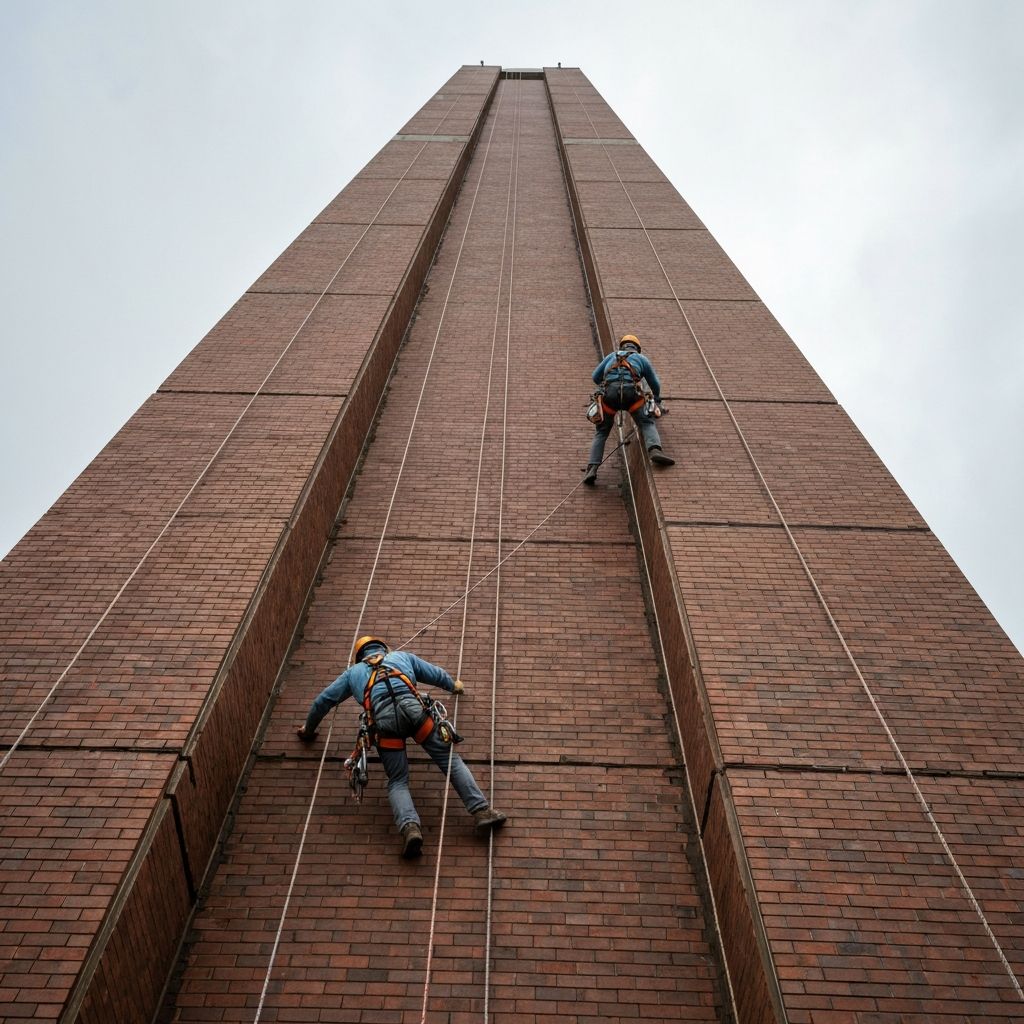
Technician working at height on the masonry of a multi-storey building elevation

Repointing Newcastle

Repointing in Newcastle for brick and stone elevations.

Worn mortar joints let rain soak into walls, chimneys and parapets long before anything shows indoors. Asset Access rakes out and repoints high or awkward elevations across Newcastle by rope access, matching the mortar to the masonry rather than reaching for hard cement by default.

L3
IRATA Level 3 led
Lime
mortar for older masonry
No scaffold
on most upper elevations

01 - Service Detail

Specialist access for Newcastle buildings.

We plan the access method, inspection route and repair sequence around the building, the defect and the disruption risk.

Choosing the right mortar

Mortar should always be softer and more breathable than the brick or stone around it, so that moisture escapes through the joint and not through the face of the masonry. Pre-war buildings were laid in lime, and patching them with a dense cement mix traps water, which leads to spalled bricks and crumbling stone edges. We match the mix, colour and joint profile to what is already on the wall.

Natural hydraulic lime for historic brick and stone
Cement-based mixes only where the masonry suits them
Joint profiles matched: flush, weathered or recessed
Sample panels on visible or sensitive facades

Sandstone, Grainger Town and older Newcastle facades

Much of central Newcastle, including the Grainger Town streets around Grey Street and Grainger Street, is built from local sandstone, while Jesmond, Heaton and Gosforth have long runs of Victorian and Edwardian brick terraces. Soft sandstone is easily damaged by hard pointing, and many buildings in the city centre are listed or sit in conservation areas. On these elevations we use lime, work carefully by hand and flag anything that may need consent before we start.

Sandstone ashlar and rubble walls
Victorian brick terraces and bay fronts
Listed and conservation-area buildings
Old cement pointing carefully removed where it is causing harm

Chimneys, parapets and gable ends

The parts of a building that need repointing first are usually the most exposed: chimney stacks, parapet walls, copings and gable ends facing the prevailing weather. They are also the hardest to reach from the ground, which is where rope access saves a scaffold programme. Joints are raked out to a sound depth, typically at least twice the joint width, before new mortar is packed in and finished.

Chimney stack repointing and flaunching
Parapet walls and coping joints
Exposed gable ends and upper elevations
Raking out by hand to a consistent depth

02 - Proof

Why Asset Access fits this work.

Masonry repairs led by an IRATA Level 3 technician
Around 30 years of combined experience working at height
North East company working across Newcastle and Tyneside

03 - How It Works

Clear process, practical output.

Survey the joints

We check mortar condition, masonry type and exposure, and photograph the joints that are open, cracked or previously patched.

Match the mix

We agree lime or cement, sand colour and joint finish, with a small trial area where the elevation is visible.

Rake and repoint

Old mortar is removed to a sound depth, joints are dampened and packed in layers, then finished to the agreed profile.

Cure and review

New lime work is protected while it cures, and you receive photos of the finished joints alongside any other defects we spotted.

04 - FAQs

Questions customers ask before booking.

Should my Newcastle property be repointed in lime or cement?

If the building dates from before about 1920, or is built of soft brick or sandstone, lime is almost always the right choice. Cement suits some modern, hard-fired brickwork. We check what is already there and explain the reasoning before quoting.

How do I know if my walls need repointing?

Look for recessed or crumbling joints, mortar you can scrape out with a key, plants growing from the wall, damp patches inside on exposed walls, or bricks and stones with damaged faces. Chimneys and parapets usually show it first.

How deep are the joints raked out?

As a guide, joints are raked out to at least twice their width, or back to sound mortar if that is deeper. Going too shallow leaves new pointing sitting on a weak base, and it will not last.

Can high-level repointing be done without scaffolding?

For chimneys, parapets, gables and sections of upper elevation, rope access is often practical and avoids scaffold hire and pavement licences. Repointing a complete multi-storey facade may still be better value from scaffold, and we will say so.

Need this work in Newcastle?

Send the location, photos and access details and we will come back with practical next steps.